Showing posts with label Nepal. Show all posts

Monday, July 30, 2007

A True Road Warrior

American Airlines' in-flight magazine, American Way, is holding their yearly Road Warrior contest. The winner wins two million Hilton points and one million AA flier points. Pretty good, huh? Anyway, besides a bunch of questions about my "demographic" and some questions about articles written in the mag (answers are easily discovered via Google and Wikipedia), they want you to present three photos with captions that prove you're a road warrior and to write a haiku about being on the road. Here's my application, and when Justine submits hers, I'll post it here, too.


Picture 1: One is often faced with adversity, but only true Road Warriors can overcome even the most nefarious hazards and live to tell about it [China].


Picture 2: Sometimes planes, trains, and automobiles are delayed, but true Road Warriors find a way -- even navigating the dangerous streets alone [Laos].


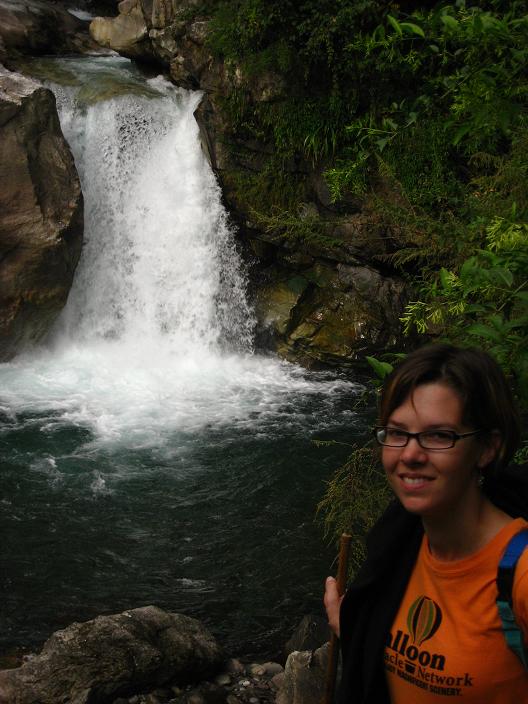
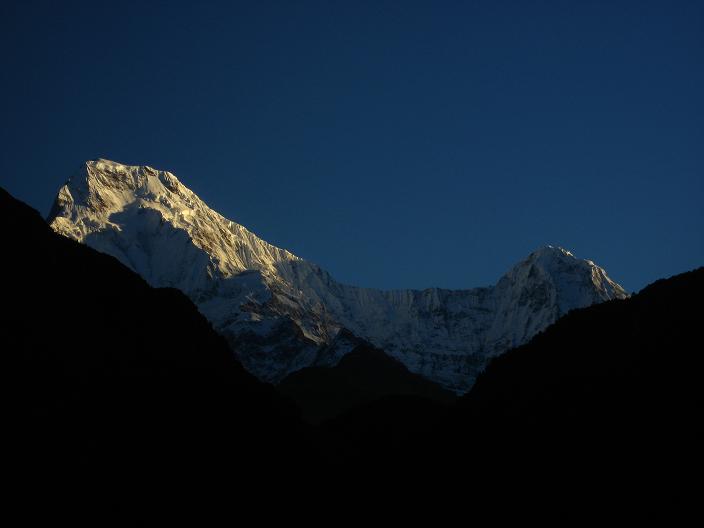
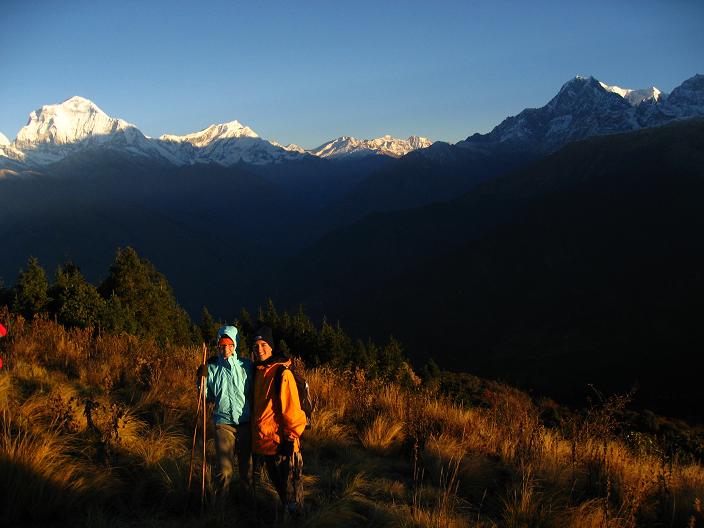
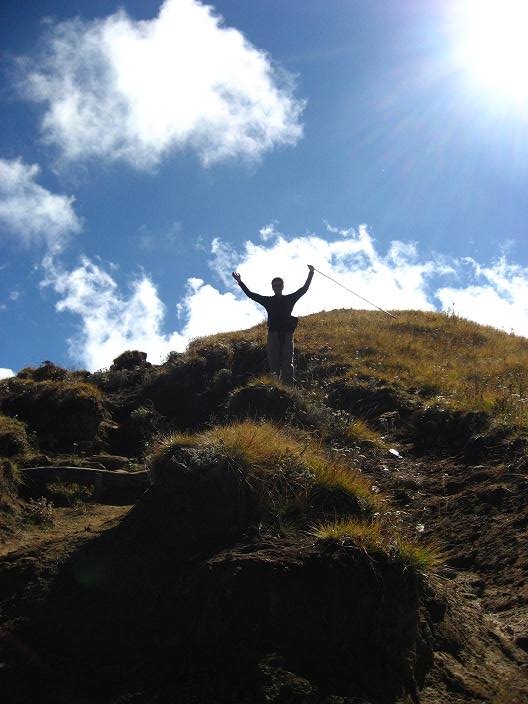
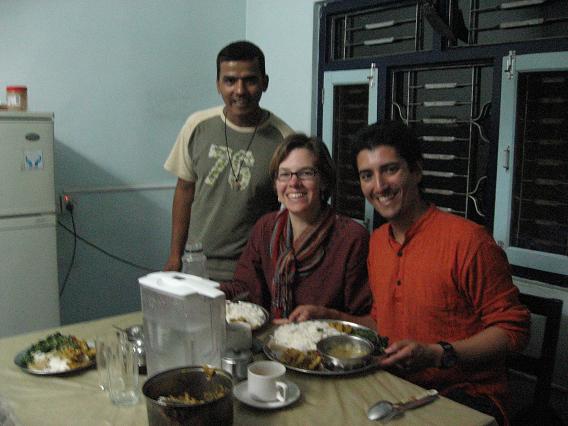
Picture 3: Cold weather, rain delays, early morning commutes... a true Road Warrior pushes on and is rewarded for his or her struggles [Nepal].


The haiku I wrote is as follows:

In Asia, beware!
Potable water is scarce
Prepare for the runs


-Mike.

Posted by Picasa

Monday, January 01, 2007

The long awaited story of our Nepali river rafting experience, by Justine

There has been high demand for the full river rafting story, so I have finally finished it, the blog bum that I am. I don't spend much time on the computer but here in Singapore we are afforded a bit more technological luxury, so here it is! And yes, it is a long post.

I have been river rafting once before, as a Girl Scout, when I was about 10 years old. I and the other youngest girl in our troop were thrown in the boat with our two troop leaders since we were too young/small to navigate the waters on our own. Laneisha and I screamed, laughed, and cried our way down what seemed like a watery roller coaster ride. It was such a thrill that I have been wanting to try it again ever since. Fast forward almost twenty years later, here in Nepal, and there is no excuse I can give to *not* try it again, since we are apparently in rip roaring rafting country...

We delayed our rafting trip by a few days due to what at the time we thought was giardia. We left early in the morning by bus with our group of about 25 people to reach the upper Bhote Kose River, about three hours northeast of Kathmandu. After being abandoned by our bus driver, who stopped the bus in a small town and walked off to "visit family", (he was replaced an hour later by some guy off the street who stalled the bus every time he hit the brakes, which was probably not frequently enough) and skipping the promised tea break, we were more than ready to get off the bus, stretch our legs, and eat whatever lunch they put in front of us: cold noodles with mustard, some salad and peanutbutter with bread. Thank goodness for the peanutbutter!

While lunch was being made, we helped our guides prepare the rafts. Lunch was shared with a local dog and a few cows. Afterwards we had a training session on the river side, where the water was so loud many people (including Mike) couldn't hear the instructions. We then seperated out into the three rafts with 9-10 people in each raft (including the guides). A safety kayaker would accompany us down the river to scout out tough areas and be on hand in case anyone fell out.

Mike and I, along with the one other American on our trip, a group of five Polish travelers and our guide Kamel led the three rafts down the river. We practiced rowing, turning, "getting down" (ducking and holding on) and sliding to one side of the boat (to prevent capsizing). Getting eight people to do everything correctly at the same time is more challenging then you might imagine, particularly when the guys in the front had some trouble with the English instructions from our Nepalese guide.

Kamel made certain that those who screeched the loudest (guess who) got the wettest, so we entered several rapids at deliberately poor angles, oftentimes spinning into them as if we had no control of the boat -- good practice for reality.

That night, Mike and I teamed up with an Australian couple and conspired to rearrange the boat groups so we could be with others who might be more compatible (that is, follow directions, understand English, and row consistently). The next day the four of us and another British couple (who Mike and I had met briefly in Songpan, China -- small world!) ended up in a boat together. We were quite pleased with ourselves. We started off north of the dam, which is known to be rougher than the south side. Before long, the river was tossing us pretty well, but as a team we were working together.

Our learning experience began when within half an hour of putting in, we hit rapids at an odd angle and two of us flew out of the boat -- I was one of the lucky two! I had prepared myself mentally for the possibility of landing in the icy water, getting a mouthful of it, and testing my swimming muscles, but once I hit the water all that confidence went swirling downstream. I was immediately swept under the raft itself, and as I came up for air I was met with a hard plastic wall and more water. In the maybe ten seconds that I was under, which as you can imagine felt a heck of a lot longer than that, I went from "I'm gonna drown under this raft!" to "wait a second, I can do this" and climbed out from under the raft just as our guide had taught us, by treating the boat like a ladder and pulling yourself in one direction. As soon as I surfaced I was hauled from the water and scrambling to get back into position with my oar, even as another one of our team (Neal of the Brits) was still swirling in the water. Mike tells me that I flopped into the boat laughing, and remembering that now, I was probably congratulating myself for having survived. He wasn't too impressed with the experience of seeing me disappear and after the adrenaline wore off, I realized that I was mildly traumatized as well. But wait! It gets better!
Our next segment down river had another one of our people go down, the other half of the British couple. After we hauled her back into the boat, all three boats pulled over to take a break. We took a few breaths, clambered back into our rafts and revved up for the next test: avoiding a huge series of boulders just downstream. The safety kayakers went ahead to asess the situation and communicate to the guides the best approach, which was to cut straight across the river to the far bank and let the current sweep us past the danger zone. Our team watched as the two other boats dug their oars in and powered across, just above the boulders. Our guide explained our plan of attack, emphasizing strong rowing, and we rallied a battle cry although we all knew we would surely be going for a swim.

I would have liked to have seen this all transpire from the river banks, because we were probably a pretty comical sight -- within just a few yards of our drop in point we were spinning right for the rocks. All we could do then was GET DOWN and hold on. It seemed we had as good of a chance making it across if we had just curled up into balls on the floor of the boat. Going over the boulders threw Dylan from the boat, taking Mike out with him before becoming a dot in the white water and disappearing downstream. For a moment the boat tipped on to its side, the bottom of the boat parrallel with the waterfall we had just gone over. Mike somehow managed to hold on to the raft's ropes and was looking up at us from below. Once the boat became level again, rather speeding off downstream after Dylan, our boat was trapped in the waterfall/whirlpool created by the boulders. For what seemed like an eternity we were stuck in a slow motion see-saw, having to throw our weight from one side to the other to keep from tipping over. The boat was so full of water that we were standing to keep our balance. After the initial shock of going over the rocks and trying to stay on top of the water, panic set in for Marriane and I -- she because her boyfriend was swept downstream, and me because Mike's face was nearly all that was visible as he clung to the edge of the boat trying not to get pulled away by the rapids. The horrible see-sawing, the roar of the water slamming over the rocks on top of us, and the complete helplessness of the situation was overwhelming. Our guide did his best to keep us together, and at one point it seemed like the only way we would free ourselves from this watery purgatory was just by jumping into the river. In retrospect, through all my screaming and everyone's flopping around, I realize our guide was calculating and waiting. At the precise moment that the boat freed itself, our guide heaved Mike back into the boat and we were flying downstream again.

We had to maintain some kind of composure and continuing rowing several mintues after the waterfall experience, minus one of our oars which had disappeared. When we finally beached we were relieved to see Dylan in one piece and drying in the sun -- he was picked up by a kayaker. At this point the drama had been enough. Mike and I had swallowed and inhaled our share of river water and couldn't stomach the lunch that was prepared. Standing on hot, knobby rocks never felt so good. Nothing could convince me to get back into the boat, and I didn't feel one bit bad about it. I was perfectly content to sit on the beach and wait for everyone else to finish their adventure before heading back to Kathmandu. Mike agreed, and so did the British couple. Thus our river rafting experience ended a few hours early, but I look at it in terms of the quality of our experience, which was just crammed into a shorter period of time. More bang for our buck.

As we discussed later, the six of us learned that being a part of a couple in the same boat makes rafting a lot more complicated. In addition to worrying just about yourself, you are constantly keeping an eye on your significant other to make sure they're still in the boat too. Even if you are perfect teammates in terms of being able to read each other in the boat, you are handicapped by your concern for the other. It also didn't help that all six of us could probably be classified as "light weights" -- either short, skinny, or both. Not much muscle power, and certainly not enough weight to keep the boat from tipping easily.

Mike and I both developed "river coughs" and had bruises that lasted well into India. My left elbow still hurts when I put pressure on it. As a final note, a week or so after our trial by water, I looked up the criteria for classifying river rapids. It is likely that the 3s and 4s we were going through in Nepal would be deemed 4s and 5s (on a scale of 1 to 6) back home. Does this make us expert rafters?

Sunday, November 12, 2006

Trekking in Nepal (Part II)

Read Part I here.

Just the pictures.

Before I continue, I want to make something perfectly clear. When I said that the trails are just the roads that Nepali people use to move around between the mountain villages, I don't want to suggest that the roads are flat or paved or in any way easy to get around on. There are the cut stone stairs (made of slate taken from the mountains), which makes steep ascents and descents possible, and on the "flat" ground there are usually stones of some kind to keep the roads from falling apart, but they are still very rough (see an example of one of the nicer sections of the road here). These walks are not for the faint-hearted (James, I'm looking your direction), but we did see a woman being carried on the back of a porter in a special chair, followed by another porter carrying her wheel chair (so James, maybe Meghan can carry you on her back!). The walks also aren't too difficult, since the trails are well marked and you don't need special gear or climbing tools... we just wore sneakers and the same clothes every day. And since you stay in lodges, you don't need a tent or food, just a water filter or Iodine (or money to buy tons of bottles of waters, which as I discussed before, is something we're not interested in). Because the trails are really just roads, J and I always laugh at the people who are walking around in huge hiking boots and gore-tex jackets and huge 50 L bags and separate day bags and titanium walking poles, etc.... it's a joke. I'm not sure what these people think they're getting in to, but I assure you, you can do this with just a light water-proof jacket, a fleece, pants, a t-shirt, sunglasses, a sun hat, a warm hat, and tennis shoes.

I also want to mention, since this doesn't appear anywhere in my journal, that the weather and views were pristine for the entire 7-day trek. It was a bit chilly most nights, but during the day, the sun was always out, the sky was so blue you couldn't believe your eyes, and the hugest mountains in the world were just a few miles away... Really, we couldn't ask for better weather that what we had. It was usually around 75 F during the day when we were walking, and although it usually started to get cloudy in the evening, at night the full moon (or nearly-full moon) illuminated the mountains to give us a totally different view than we had during the day.

Finally, instead of including pictures in the actual entry, I've linked to them in the text, so when you see a link on this entry, they all go to pictures of the things I'm talking about. Not all the pictures are linked, however, so feel free to read and click pics as they come along, but also to look at all the pics I've posted (only 23 more than yesterday) when you're done (see above).

Day 4 - 6.Nov

To lower Chomrong (~2100 m)

Start time: 9 am
Lunch: Noon (1 hr in Taglung; good Daal Bhat)
Finish: 315 pm
Dinner: 6 pm (excellent Daal Bhat!)

Started the day with monkey watching (pic is of the comon langur) in Tadopani before taking a steep descent through a mossy oak forest. We soon emerged in an open river valley (pic) with terraces on all sides. We climbed up and down (as usual!) two ridges before cutting across the tops of 2 more ridges and then reaching Chomrong. Since most of the scenery was terraced farm land, it was uninspiring to me (compared to the previous 2 days), but J enjoyed it a bunch and I must admit that it was somewhat interesting for the sheer amount of terracing. Justine also picked up a tomato that grows on trees here, and is used to make the spicy pickeled stuff in the daal baht, which I don't personally like. But when we tried the tomato fresh, it was quite delicious; simultaneously spicy, sweet, and juicy.

The last climb we had, just after lunch, was probably the steepest set of stair we've ever seen: we climbed at least 6 or 700 m in only a 1 km distance! This wasn't the usual road to Chomrong, but a landslide had destroyed the old trail, so we had to follow a new one up to the top of the ridge. On the plus side, most of the rest of the hike after that was on a nice soft dirt path, not the slate stones, which made it seem more like hiking and less like walking the porters' road. We also met up with the German couple from yesterday's lodge on the trail, and we walked and talked with Birget for much of the day (her husband had blazed on ahead, as he's trying to make it to Ann. Base Camp in four days).

Day 5 - 7.Nov

To Jinhu Danda
Start time: 9 am
End time: 10 am

To the hot springs
Start time: 1030 am
End time: 1115 am
A short walk downhill from Chomorong today took us to the tiny village (with only 3 lodges!) of Jinhu Danda. Our hotel was a "short" 45-minute walk (pic) down to the river and 3 natural hot springs (pic). The springs are man-made pools (of slate stone... what else?) that collect the hot water that comes right out of the side of the mountain). We bathed in them for about an hour before it got cloudy and started to rain (just as we made it back to the hotel!). Besides Bharat and the pool's donation collector, we were the only ones there to enjoy the springs and the views from the bottom of the steep canyon were amazing, with lush greenery on all sides! At night, it got really cold and we drank about 3 pots of hot chocolate and played Big 2 and gin for hours.

Day 6 - 8.Nov

To Deurali
Start time: 830 am
Lunch: Noon (1 hr in Landruk)
End time: 5 pm(!)

The longest and possibly the toughest day on our trip, we finished with 2 hrs. of stairs (maybe we climbed a thousand or more for 1 km uphill) up to Deurali. This extra-long session was designed to have us avoid any climbing for tomorrow, our last day. The terrain today was quite diverse, beginning with a climb down to the river, which housed lush nearly-tripical vegetation and huge bolders in the areas nearby the water flow. A slow climb through a thinly-packed forest brought us to terraced hillsides above the river (probably 500 m up) and back towards civilization (Landruck is quite a large village). All around us, as far as the eye could see, the hill were being farmed and grazed, and whereas most of the morning Annapurna South and Hiunchuli were in clear view out the western end of the canyon, from the terraces the mountains fully disappeared until we reached Deurali. In addition, because we walked so long and so late, the sun was mostly down by the time we finished climbing the steps to Deurali, so we were sweaty but freezing because it was dark and the wind picked up a bunch. Although we both "showered" (using a bucket of hot water each) when we got to the lodge, it wasn't until we got into the dining hall where the fire was that we began to warm up.

At the lodge, we met a nice Australian chap named Greg, and his porter/guide named Prim, who joined us in playing Big 2 with Bharat. The food was good, the fire hot, and the babies (of the lodge owners) were super cute! In the morning, we ate pancakes, muslei, potatoes, and Justine just had to order some apple pie!

Day 7 - 9.Nov

Back to Pokhara
Start time: 945 am
Lunch: 130 pm (Phedi)
Took a taxi back to Pokhara and arrived at our hotel (pic) at 230 pm

A rather boring walk down from Deurali through Dampus (pic), which has gorgeous views of the whole Annapurnas, to Phedi was somber and sad. Worst of all was the 20-minute walk down the road at the end of the trail to the Phedi and the HORRIBLE daal bhat at the restraunt while we waited for our taxi (the rice tasted like cigarette smoke... blech!). After so many good meals, slience, stunning views, and clean air, it's a total bummer to be back in the world. Even yesterday was a sad reminder that the trip was ending, as we were greeted with numerous "one rupee, pen, sweet?" calls from the kids in Landruck.* We also saw several groups of trekkers numbering 12 or more making noise and carrying around their huge bags and shoes, which was another sad reminder that our time here is done.

* These are the usual things that kids in Nepal beg for, even though they rarely need food or pens for school. It seems that some tourists, rather than giving money, started giving out candy and pens, or letting kids try on their sunglasses. This means that now, every child in Kathmandu and Pokhara demands that you give them something, whether or not they even need it. It turns out that the kids just turn around and sell the pens to other tourists, and it has become quite annoying. It had been days since we had heard these calls, so Landruck was a powerful reminder that we were almost back.

It's strange that I really feel as if part of myself is left back in those mountains for me to come back and rediscover. I spent a lot of time in my head these last 2 days and I've come to two conclusions that are probably the same thing:

1) I'd like to be more giving of myself and my time. [Part of the reason we started volunteering at the Nepal Children's Welfare Association after our trek, though we had planned to do this, anyway... see Part I and we'll have another post about this later.]
2) The world is so huge, but people aren't so separate.

Basically, we saw that people here and everywhere (cities and villages in Nepal, China, Japan, America) live and breathe and work the same as you. They might do different things, but you really get a chance to see that you're the same. You meet other travellers, too, and they instantly know you and bring a sense of community, trust, and belonging. Really, you are the same as everyone else and to do wrong or harm to others (or to hold grudges) is to do wrong and harm to yourself. How can you live if you can't forgive yourself? How can you survive if you don't give to yourself? It seems silly or maybe obvious now that I'm writing it, but I can't express in words here how I really do feel more connected to other people through this trekking and all of our travelling experiences.

Day 8 - 10.Nov

Dinner at Bharat's (see here for pictures) in Pokhara.

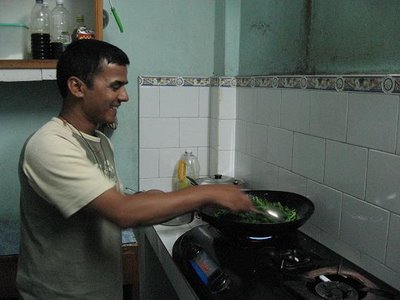
Bharat cooked us Daal Bhat tonight, and it was possibly the best dinner we've had this whole trip! Here's how it breaks down (Bharat, please correct me if I made any mistakes in the ingredients!):

-Tons of spinach/chard, chopped. Cook in a bit of water with oil, salt, chopped onion, and shredded garlic and ginger

-Daal/lentil soup, cooked and served plain with a bit of oil, salt, and termuric.

-Veggies, cubed potatos, cauliflour, minced onion, shredded garlic and ginger, salt, turmeric and cumin. Fry in a bit of oil the potatos with the onion and salt. Add the cauliflour and other ingredients when the potatos are half-way finished and add a bit of water, if necessary, to soften them.

-Sauce (Baan?), Hemp seeds, toasted (substitute with toasted almonds in the States where hemp isn't available?). Fry some tomatos with chili powder, garlic, and cumin. When done, blend the tomatos with the seeds/nuts until smooth... add water if necessary. (This was the tastiest part of the meal!)

-Plain white rice.

-Pickeled stuff that was made before we got there.

Serve all together on a huge plate and enjoy!

Saturday, November 11, 2006

Trekking in Nepal (Part I)

I can't possibly describe our whole trek right now in any kind of detail, but I'll try to do it a bit of justice using a fraction of a percent of our photos and some of my journal entries. The northern boarder of Nepal is all Himalaya, with Everest region in the east and the Annapurna region in the west. The gateway city to the Annapurnas is called Pokhara, which is where we've been staying and doing yoga for several days before beginning our trek, and where we currently are staying until Tuesday this week, when we return to Kathmandu to prepare for our flight to Kolkata, India on Sunday. Here in Pokhara, we met a ton of really nice people, including our Belgian hotel owner/NGO operator, Sabine (hotel, Nepali orphanage, Belgian NGO) and her Nepali husband Ram (both of whom helped us organize our trek), our German yoga/meditation teacher, Ms. Petra, an Australian lawyer named Christy, a Canadian TV producer working in Mumbai (Bombay) for the last two years, Lindsey, and an American salesperson/traveler from San Francisco, Lana; both Lana and Lindsey became our yoga partners for 6:30 am sessions with Ms. Petra!

Anyway, you can think of the major peaks in the Annapurnas as a crescent-moon shape, with the opening to the south and the peaks called Annapurna South and Hiunchuilli at the south-west tip of the crescent, and Machhupucharre, or fish-tail mountain (so-called because of it's twisted double peak), at the south-east. The two most famous treks here are the Annapurna Circuit, which goes around the outside of the mountains and takes about 20 days, and the trek to Annapurna Base Camp (also called the Annapurna Sanctuary trek), which takes you into the middle of the crescent moon and takes about 10 days round trip. Of course, there are tons of trails and we met people who had been in the Annapurna region (a protected area under the Annapurna Conservation Area Project, or ACAP) for 40 days and more! We took a simple 7-day trek starting in a village called Birethanti, south and west of Annapurna South. We walked north and east until we were literally 5 miles from Ann. South, cut across the mouth of the crescent moon to the Sanctuary trail near Fishtail, and turned south out of the mountains where we caught a taxi from Phedi back to Pokhara.

I should also explain that hiking up here isn't like it is back home in the States, or elsewhere in the world. The "trails" we're walking are really just the roads that the local people use to walk between the villages, farms, rivers, and cities of Nepal. There are little to no camping facillities anywhere along the road; instead, people stay in the guesthouses that have sprung up in each of the villages. Some are really nice, but most are just modest rooms with two beds, no heating, and plywood walls. If you're lucky, there's a toilet and shower inside the building somewhere. If not, there's at least a toilet outside. Accomodation at these guesthouses for doubles runs from about 100-200 Nepali Rupees (that's 70 NRs per dollar, so 100 NRs is about $1.50), and food is about the same. So in any given day, Justine and I spent about 2000 NRs, not including our guide.

Speaking of which, there's a new rule in Nepal that was implemented just days before we left: In addition to the ACAP entry fee (2000 NRs each), the Trekking Agents Association of Nepal (TAAN, which is just a travel agents' union) started requiring people to book treks through them, which costs an additional 250 NRs each. This means there is no more independent trekking in Nepal... you MUST book a porter (dude to carry your stuff), a guide (a dude to tell you where to go), or a porter/guide (a combo), AND the booking must be made through a unionized agent. We got a single porter/guide, named Bharat, to carry our one backpack (stuffed with a few clothes, two rented sleeping bags, meds, and our water filter) who is a friend of our hotel owner (Sabine).

On the first day, we took a taxi out to Birethanti from Pokhara, which took about 90 minutes, registered ourselves and our trek, and that's where I'll start. For height references, one meter is about 3.3 feet, Everest is 8848 m (~29000 ft), Mt. Whitney in California is 4421 m (~14500 ft), and altitude sickness usually sets in at about 3000 - 4000 m (~10000 - 13000 ft). Also, on our horse trek in China, we camped at almost 3500 m and the Ice Mountain lookout we went to was at 4500 m. Also, when we were in Pokhara, we spent 1100 NRs buying two trekking poles. Naturally, we left them behind in our hotel and bought two excellent bamboo poles for 100 NRs about an hour along on the trail; these would serve us extremely well. Okay, here we go:

Day 1 - 3.Nov

Birethanti (1025 m) to Uliri (2010 m).
Start time: 930 am
Lunch: Noon (1 hr)
End Time: 345 pm
Snack: 4pm (Pancakes and porrige)
Dinner: 715 pm (Daal Bhat, the traditional Nepali meal of Lentil soup, rice, veggies, pickels, and other stuff, depending on who makes it.)


Climbed the dreaded "Stone Staircase" today after descending an additional 100 m into a river valley and past a landslide which has killed the power in Uliri and other villages up here. At the start of the day, we were "asked" for a "donation" of 100 NRs to the Annapurna shrine. Saw many spectacular waterfalls and riverside scenery. The dogs here are huge and gorgeous, and the chickens numerous and cute! Of course, Justine is obsessed with them. Her Nalgeen went "missing," taken hostage by two teenaged Nepalis who seemed like they'd only give it back to me in exchange for money. We'll just buy another one when we get back to Pokhara, rather than give encouragement for steeling people's sh*t. Anyway, after lunch, we walked along a river for a short time before crossing over on a rickety suspension "bridge" and started up. The climb lasted for almost 2 hrs.!


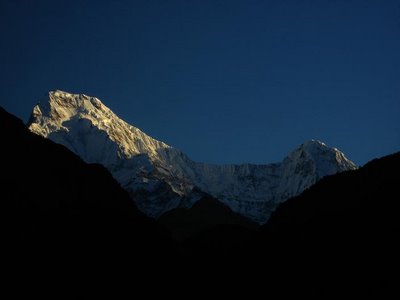
Bharat, our guide, taught us to play Canongat (sp?), a billiards-type game played on a square table with giant tiddly-winks... you flick the cue disc (called the "shooter") with your fingers. The views of Annapurna South and the ridge across it to Hiunchuli were stunning after the clouds lifted. [See for yourself:
]

The Maoist checkpoint at the start of the trail was efficient and professional, but lame anyway. At the lodge, a guy from Singapore and his 5 friends from HK lugged a bunch of Absolute vodka and limes up here. They gave us a bunch while Justine, Bharat, and I played cards and sipped Nepali tea. [ed. note: the Maoists are a group of rebel separatists in Nepal who have been waging war with the King until he relenquished power back in April and the democratic parties of the parliment (called the Seven Party Alliance) since at least 1999. Two days ago, the Maoist leader agreed to join the SPA and make the Maoists a ligit member of the Parliment, which means a cease-fire has been arranged. Almost none of the Maoist activity directly effects the tourism industry of Nepal, except for the trekking fees levied by the Maoists, which is a form of extortion, since it is not government authorized. Back in the day, Maoists roamed the trails with guns and took money as they saw fit, charging some tourists, specifically Americans, 100 USD! More recently, they have set up tables and started charging 100 NRs a day to everyone (except Nepali people) in the trekking regions, don't wave guns around tourists, and give you a printed reciept. Someone told me they sold their reciept to another American on eBay as a keepsake... why?]

Day 2 - 4.Nov

Uliri to Ghorepani (2750 m)
Start time: 845 am
Lunch: Noon (1 hr in Nangethanti)
Finish time: 2 pm (Hungry Eye Guesthouse)
Dinner: 6 pm (Dall Bhat)

I thought we were done with the stone staircase, but it just continued for another 1.5 hrs. this morning! We then entered an oak and rhododenderon forest area, whcih was much flatter and had beautiful rivers and huge waterfalls everywhere. We met a woman at lunch named Julia (from Seattle and who sounded exactly like Sarah Vowel) who knows all the same people in Pokhara as we do, even our guide, as this is her tenth time trekking in Nepal! A very small amount of rain fell on us today but the sun was strong, anyway. In the evening, we did laundry outside in the freezing cold wind, but used the fire inside to dry our stuff. We played cards with a Welsh couple (Tristan and Jess) who were finishing the Ann. Circuit trek on their own. Although we rented sleeping bags from Sabine, I got stuck with her daughter's bag, which barely covers me up to my chest. Tonight, I'll get blankets from the lodge and use those, instead. Tomorrow at 430 am, we'll start our walk up to Poon Hill at 3200 m to view the sunrise over the Annapurnas. I think there will be about a million people up there with us...

Day 3 - 5.Nov

to Poon Hill (3200 m)
Start time: 5 am
Finish time: 540 am
Breakfast back in Ghorepani: 8am

to Tadopani (2590 m)
Start time: 915 am
Lunch: 1 pm in Banthanti (1 hr.)
Finish time: 340 pm

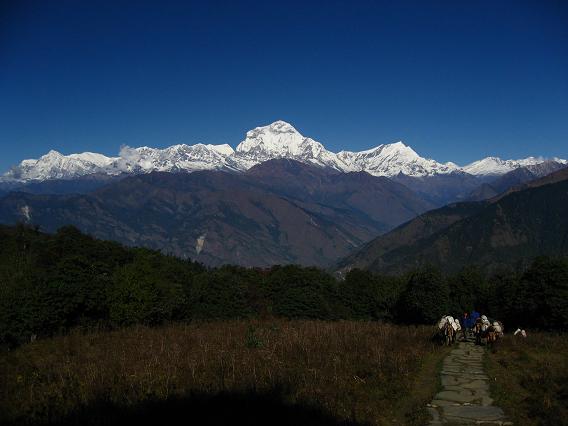
View of Dhaulagiri (far left, 8167 m, 7th tallest mountain in the world), and Annapurna I (8010 m, 10th tallest, with a bit of light on it at right) with Annapurna South (7219 m) just starting to get cutoff on the right.


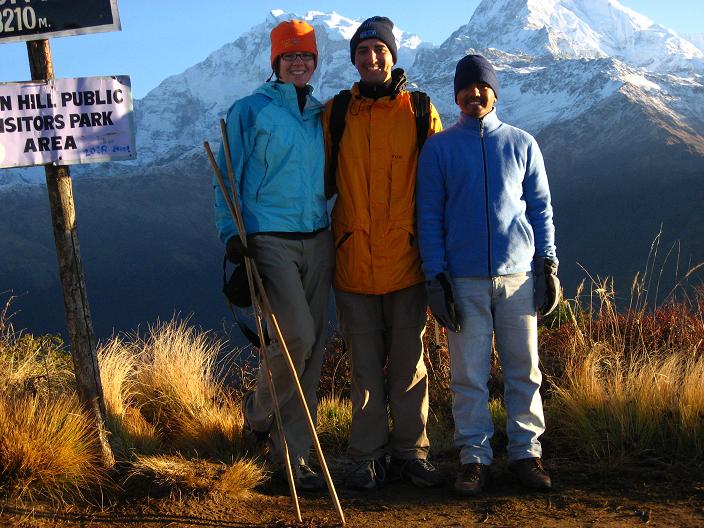
With our guide, Bharat, standing at the Poon Hill sign with Ann. I and Ann. South in the background.


The climb to Poon Hill was straight-forward but up a steep flight of stairs... I guess that's how all the trails/roads will be up here: Everything is "paved" with cut slate stones and the stairs are all uneven and so steep. But I guess that's the reason why: if they were dirt roads, everyone would be slipping and sliding everywhere and porters wouldn't be able to bring in supplies easily. ANyway, the sunrise views we shared with 100+ people in literally freezing weather were amazing, even though it was loud and annoying to be with so many people. I felt the views from the hill across from Poon Hill that we had around 10 am were far more rewarding and moving for the sheer silence. Also, the entire range was lit up and I swear you could see the earth's curvature from up there (see below). For the first part of the hike (after the better-view hill), we walked through an open and airy oak/bamboo forest area. The sun was bright, but the canopy above caused it to be just perfect inside, and the air was cool. For the first time, we walked on some Nepali-flat ground (a little bit up, a little bit down), but it wasn't as bad as the previous two days. The forest was like a happy, magical place, with views of the Himalays on the left and an open valley with trees of orange, red, and green on the right. After lunch, the trail went downhill past amazing river scenery, and the waters coming out of the mountains cascaded down countless 5, 10, and 20 foot waterfalls. We then started up a steep (they're all steep!) and exhausting ascent through a tropical, lush jungle... not quite the kind of terrain I'd expected in Nepal, but again, totally awesome. I think today was the most beautiful scenery I've ever seen anywhere, from the highest mountains in the world to colorful river valleys and open forest and jungle... we ran the gamut today! Unfortunately, we ended up in a dump of a place with a ton of loud Australian trekkers. The walls in our room don't reach the floor or ceiling, the windows don't close, and there's no light, but the food is good and we played cards all night again with Bharat and a German couple (Birget and ???), as well as another porter. We've been playing gin rummy and a game we call Big 2, but I think it's also called a$$hole. The funniest thing is that Bharat is totally enthusiastic and laughing and really enjoys playing. He's so excited when he wins, slamming down his last cards and gloating! Earlier today, he laughed for like 10 minutes when J joked about wanting me to carry her up the stone stairs... I thought he was going to pee himself.


Okay... I can't really write anymore, right now, but I'll leave you with a few pictures of what happens later in the trip because I've already put them on the page. Briefly, the trek went off without a hitch, we got back and took Bharat out to dinner, and he cooked us Daal Bhat the next night. The day after that (which was yesterday, Saturday) we started some volunteer work at an orphanage in Pokhara and took the kids out to a Japanese-Nepali festival, which was really strange, as Nepali people were doing the cherry blossom dance and judo while Japanese dancers did traditional Nepali dance. Anyway, the last picture is not of our newly-adopted daughter, but of Justine and one of the kids from the orphanage. Enjoy, and hopefully I'll post days 4 through 7 tomorrow.

Walking through the forest on Day 3.


A better view of Dhalagiri from a hill neighboring Poon Hill (which is off the shot to the far left)... a team of horses carrying supplies are walking towards me out of the forsest along the path.
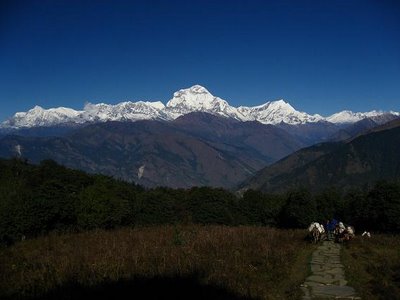


Mike with his bamboo pole standing near the summit of the hill near Poon Hill. The picture above was taken from near this spot, but facing the other way, so Poon Hill is off to the far right in this one.

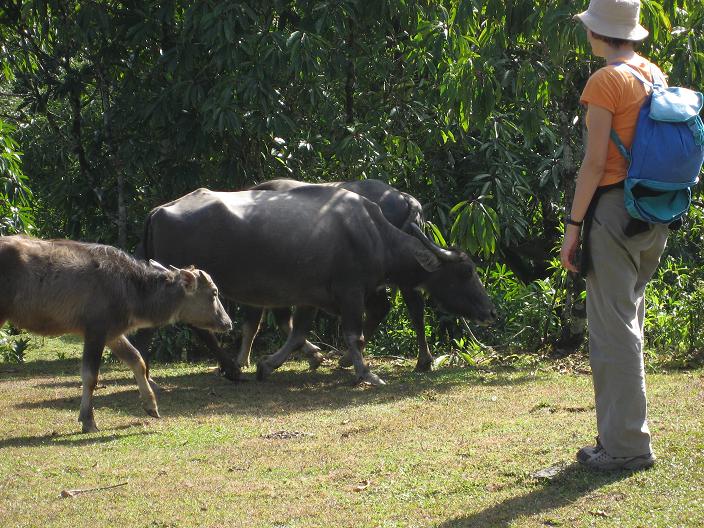
On the last day of our trek, Justine approaching a water Buffalo family near Dampus.


Playing "Big 2" with Bharat at Cafe Concerto in Pokhara after dinner on the night we returned from trekking


Bharat cooking us dinner at his home in Pokhara the night after we returned from trekking.
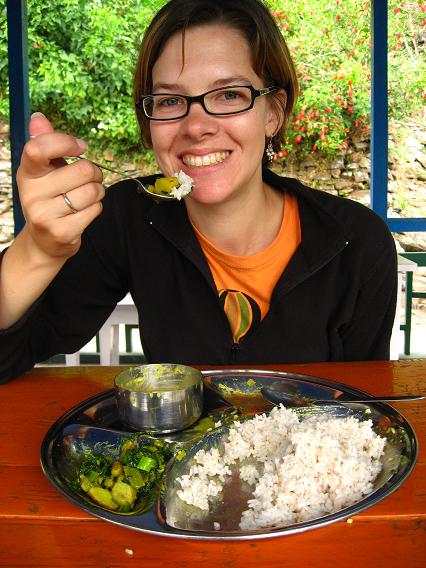
About to eat Bharat's Daal Bhat!


Justine and Mamata at the Nepali-Japanese festival.


-Mike